
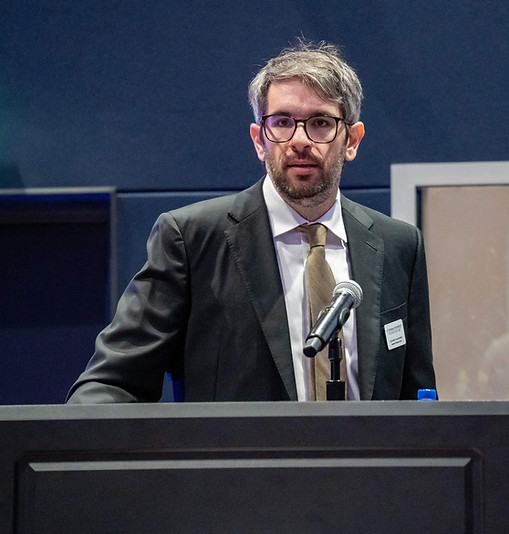
professor
zachary catanzaro
I am an Assistant Professor of Law at Widener University Delaware Law School. My scholarship examines how emerging technologies transform foundational legal concepts including property, sovereignty, and interpretation. Recent projects include articles on posthumous algorithmic control, a TEDx talk on training AI to outlive us, and testimony before the U.S. Copyright Office on NFTs and intellectual property. Contact me to discuss speaking engagements or consultation opportunities.
recent projects
My current research centers on developing theoretical frameworks for Generative Simulation exploring how probabilistic models and AI decision-making systems interact with legal reasoning. This work builds on my forthcoming Yale Journal of Law & Technology article Sovereignty in the Technological Singularity, which examines how traditional concepts of legal authority and their relationship to death must evolve in response to advanced artificial intelligence systems. Last year, I delivered a TEDx talk titled Ghosts in the Machine: Training AI to Outlive Us, addressing the implications of AI systems that persist beyond their creators' lifespans. Additionally, I contributed a chapter on Trademark Use in Web3, NFTs, and the Metaverse to an upcoming ABA publication on digital content law, analyzing how intellectual property frameworks apply to emerging virtual environments and blockchain-based assets.


Teaching
My teaching philosophy centers on making complex legal concepts accessible while preparing students for real-world practice. I believe in creating a supportive environment where students feel safe to ask questions and learn from mistakes, using pop culture references, current events, and practical hypotheticals to make abstract principles stick. Drawing on my practice experience, I focus not just on teaching doctrine but on developing the critical thinking and professional judgment students will need as attorneys. I'm committed to being accessible and patient, providing multiple learning pathways through detailed materials, extensive office hours, and hands-on experiential projects that bridge the gap between academic theory and actual legal work.


